SLS
Selective Laser Sintering
SLS sinters nylon powder with a CO₂ laser. Unsintered powder self-supports the build, freeing geometry from support constraints and producing tough, production-grade parts with near-isotropic strength.
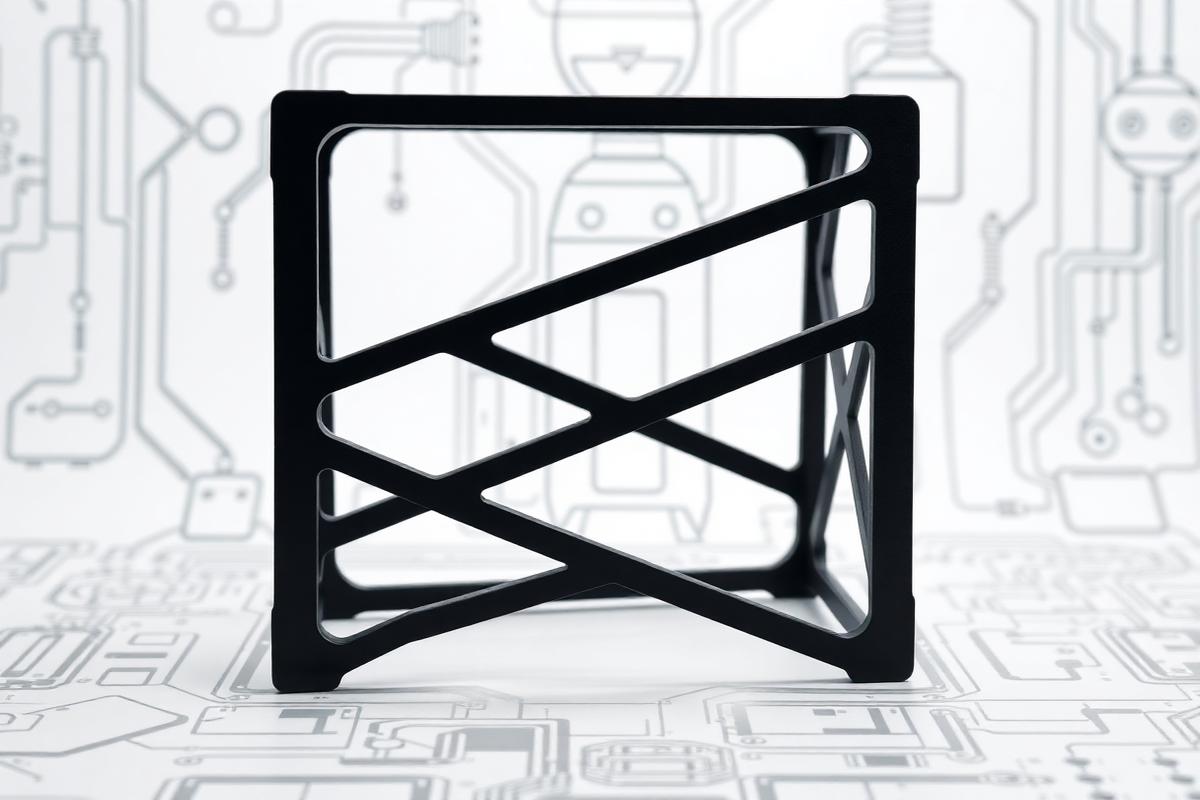 SLS · ± 0.3 mm typical
How SLS works
- 01
A thin layer of nylon powder is spread across the bed.
- 02
A laser sinters the part cross-section into the powder.
- 03
The bed indexes down; surrounding powder supports the build.
- 04
Parts are broken out, bead-blasted, and optionally dyed.
Strengths
- No support structures
- Near-isotropic strength
- Production quality
- Nesting for batches
Limitations
- Grained surface
- Limited color (dye)
- Powder evacuation needed
Design rules for SLS
Full guidance in the interactive design guide.
| Minimum wall (unsupported) | 0.7 mm |
| Minimum wall (supported) | 0.7 mm |
| Minimum hole diameter | 1.5 mm |
| Minimum feature size | 0.5 mm |
| Moving-part clearance | 0.5 mm (0.6 mm for moving assemblies) |
| Minimum embossed text | 1.5 mm height, 0.5 mm depth |
| Overhang threshold | No supports required |
| Max build dimensions | 330 × 330 × 400 mm |
- Print interlocking and captive assemblies in one build.
- Escape holes ≥ 3.5 mm are required to evacuate powder from cavities.
- Expect a matte, lightly grained surface; dyeing gives uniform color.
Compare with other processes
All technologiesFDM / FFF
Fast, economical thermoplastic parts for prototypes, jigs and fixtures.
± 0.2 mm typical · 350 × 350 × 350 mm
SLA
High-detail resin parts with smooth, injection-molding-like surfaces.
± 0.1 mm typical · 300 × 335 × 200 mm
MJF
Production nylon at scale with fine detail and consistent mechanicals.
± 0.2 mm typical · 380 × 284 × 380 mm